NOTICE
Although our practice continues, we are no longer accepting new clients.

3 Tips for Safe Hiking

Posted on Monday, January 30th, 2017 at 9:06 pm    

So you’re a hiker…or you want to be one. That’s awesome! But just like any other outdoor activity there are important safety points worth noting.

Partner up!

Obviously you need to know what you’re doing out there in the wilderness, especially if you are overnight backpacking. But if you don’t, go with someone who does! There are plenty of places to find a hiking or backpacking buddy. Mountaineers.com offers guided trips you can sign up for, plus meetup.com allows users to join groups of all interests. You can even go to a talk at REI and perhaps meet your next hiking pal there!

Choose your Route

Where do you want to go? There are many guides, maps, and websites to help you decide which route is best for you depending on distance, expertise level, how far you want to drive, etc. A great resource is the Washington Trails Association. They even have a fantastic app called Trailblazer (available to iphones, androids, and windows phones) that you can use to search trails throughout the state and save them to your ‘backpack’ which you can access offline.

You definitely need to accurately assess how much time you have, how physically fit you are, time of year (this affects temperature and number of daylight hours), and what elevation gain you can handle. You will also need to know what kind of fees are involved and whether or not you need a specific pass.

If you need to train before hitting the trail, have a look at REI’s Backpacking Training Tips and Exercises.

Gear up!

This is a much smaller and simpler task for day hikes, but there are still a number of extremely important objects to have with you on the trail. The more people that go with you on your multi-day trip, the more you can spread out the goods and share, so keep that in mind so you don’t have unnecessary duplicates. The Washington Trails Association names the 10 Essentials as:

  1. Navigation – maps, compass, gps
  2. Hydration – water, purifier, etc
  3. Nutrition – including an extra day’s worth just in case
  4. Rain Gear and Insulation – waterproofs and layers (avoid cotton)
  5. Firestarter – waterproof matches in water-tight container, backup cigarette lighter
  6. First Aid Kit – full of useful supplies for the trails, and knowledge of how to use it
  7. Tools – duct tape and pocket knife
  8. Illumination – flashlight, spare batteries, extra bulb
  9. Sun Protection – sunglasses and sunscreen (snow can reflect wicked rays from a strange angle so lather up under your chin and nose)
  10. Shelter – space blanket, tarp, tent, etc, even if it’s not your plan to stay overnight

Other important things to pack, depending on your preferences include bug spray, whistle, gloves, signal mirror, extra socks, and bright gear for hunting season.

Have a great time out there and remember to be safe. ALWAYS make sure someone knows you’re out there and your intended route in case of any emergencies.


What is Equal Pay and Why Should You Care?

Posted on Monday, January 30th, 2017 at 5:34 pm    

What is Equal Pay and Why Should You Care?

By Lori Andrus, Esq.

Although we make up 46.8 percent of the workforce,[i] today women still only earn 80 cents on the dollar when compared to men.[ii],[iii] And that difference really adds up over time. As Lilly Ledbetter—who was shortchanged for 19 years by her employer, Goodyear Tire & Rubber Company—said so eloquently in 2012: “[w]hen we lose 23 cents every hour, every day, every paycheck, every job, over our entire lives, what we lose can’t just be measured in dollars.”

Equal pay is not just a women’s issue; it’s an economic issue. Women make up nearly two-thirds of minimum wage earners.[iv] Women are the primary or sole breadwinner in 40% of households with children under age eighteen.[v] In California alone, if women were paid fairly, an additional $33 billion dollars would flow into the state’s economy, per year.[vi] Paying women what they’re owed would cut women’s poverty rate in half overnight.[vii] All of us, not just women, will benefit when pay equity is won.  

Perhaps you’ve heard that the gender gap only exists because women “choose” lower-paying fields, or because women “opt-out” of the workforce to raise children. But a 2016 Cornell University study shows that women’s work is simply undervalued.[viii] As women take over male dominated jobs, the pay drops for everyone. Apparently, “if a woman can do the job, then it must be worth less to society.”

The good news is that equal pay is required by law. If you are being paid less than a male worker doing the same or substantially similar work, you should consult with a plaintiff’s lawyer (whose services are no charge upfront and who is compensated only if and when your case is favorably resolved).

It doesn’t matter whether you believe your employer is intentionally discriminating against you because of your gender: you may have a legal claim even if the difference in pay is unintentional. 

Specifically, the federal Equal Pay Act requires employers to pay men and women doing the same work equally. Many states offer even greater protections for workers.

These laws are vital to the economic security of women workers. When women workers band together in class actions, a lawsuit can be a very powerful tool to bring about positive change in the workforce (and in society).

Every jurisdiction requires that legal actions be commenced within certain time limits, or the right to sue is lost. Because there is a limited time period to file a lawsuit, quick action is advisable.

If you are being paid less than men in your workplace, add your voice to the chorus of actresses (Jennifer Lawrence, Kerry Washington, Robin Wright and Gillian Anderson) and sports stars (like five members the U.S. Women’s Soccer Team[ix]) and demand equal pay for equal work!

If you think you might be underpaid, call Nelson Boyd at (877) 971-7601 or Andrus Anderson at (415) 986-1400.  There is no charge for you to call us and we will keep your call confidential.


 [i] https://www.dol.gov/wb/stats/facts_over_time.htm.

[ii] What is the Gender Pay Gap and Is It Real? The Complete Guide to How Women are Paid Less Than Men and Why It Can’t Be Explained Away, Economic Policy Institute, Elise Gould, Jessica Schieder, and Kathleen Geier, Oct. 20, 2016, available at https://epi.org/112962

[iii] The plight of working women of color is even starker: The average black/African-American woman makes only 60 cents to the average man’s dollar, and the average Latina makes only 55 cents.  http://now.org/leaderdoc/equal-pay-day-social-media-kit-2016/

[iv] National Women’s Law Center calculations based on Bureau of Labor Statistics, Characteristics of Minimum Wage Workers, 2014, available at http://www.bls.gov/opub/reports/cps/characteristics-of-minimum-wage-workers-2014.pdf. The term “minimum wage workers” refers to workers making the federal minimum wage or less.

[v] Wendy Wang, Kim Parker & Paul Taylor, Breadwinner Moms, Pew Res. Ctr. (May 29, 2013), www.pewsocialtrends.org/2013/05/29/breadwinner-moms/.

[vi] http://www.latimes.com/business/la-fi-equal-pay-20150902-story.html.

[vii] https://thinkprogress.org/closing-the-gender-wage-gap-would-cut-womens-poverty-rate-in-half-85bb61af8530#.tqomj0lq1.

[viii] New York Times, Claire Cain Miller, “As Women Take Over a Male-Dominated Field, the Pay Drops,” Mar. 18 2016. http://www.nytimes.com/2016/03/20/upshot/as-women-take-over-a-male-dominated-field-the-pay-drops.html

[ix] Andrew Das, Top Female Players Accuse US Soccer of Wage Discrimination, NY Times (Mar. 31, 2016), www.nytimes.com/2016/04/01/sports/soccer/uswnt-us-women-carli-lloyd-alex-morgan-hope-solo-complaint.htmel; Bill Chappel, US Women’s Soccer Team Members File Federal Equal-Pay Complaint, NPR (Mar. 31, 2016), www.npr.org/sections/thetwo-way/2016/03/31/472522790/members-of-u-s-women-s-national-team-file-federal-equal-pay-complaint.


SEATTLE NEIGHBORHOOD SPOTLIGHT: Columbia City

Posted on Thursday, January 26th, 2017 at 10:08 pm    

Columbia City, located in Southeast Seattle is a uniquely vibrant mix of life. It is broadly diverse, hosting many African restaurants, as well as mom and pop, small town venues. This has created a strong, interlaced, sense of community among its residents. Its easy access to downtown via the Link light rail allows residents who live to commute to downtown Seattle.

If you’re in the mood for cocktails crafted with freshly squeezed fruit juices, be sure to stop by Taproot, locally owned and staffed by kind people who pride themselves on fresh, high quality ingredients and a comfortable place for residents to feel welcome. Their menu is definitely varied, allowing people on all parts of the diet spectrum an option that satisfies their needs.

If all-day breakfast tickles your fancy, Geraldine’s Counter is a local hotspot that is constantly voted one of Seattle’s best breakfasts! There are plenty of other dining options ranging from hearty American to Asian, and from Italian to Ethiopian. Columbia City might be small, but you are sure to have plenty of food choices to choose from. And don’t forget about dessert! Full Tilt is a locally owned eclectic ice cream shop featuring fun flavors, all natural ingredients, beer, and pinball. If you can’t make it out to Columbia City, check out their other locations as well in Ballard, White City, and University District.

For a taste of culture and history, check out the events offered at the Bourbon Bar and Columbia City Theater, which is celebrating its 100 year anniversary this year! Another taste of culture and entertainment can be had at The Royal Room, which offers music EVERY night of the week! And bonus, it’s family-friendly until 10pm.

Seasonal offerings include the Columbia City Farmers Market on Wednesdays (3-7pm) from May to October, and the Beat Walk “taking place from 4pm to 9pm on the second Sunday of the month, from June through October, BeatWalk places an extraordinarily talented and diverse range of musicians in our neighborhood businesses, from the bookstore to the fitness center, the salon to the deli. All sorts of music from all around the world spills into the streets, creating a truly one-of-a-kind experience.”

If you’ve never visited Columbia City, it’s worth a visit on the Link light rail.


SAFETY NEAR THE TRACKS

Posted on Tuesday, January 17th, 2017 at 11:20 pm    

Unlike other parts of the country, we don’t have lots of trains, but the ones we do have sometimes are in places you wouldn’t expect them.  Train collisions are nearly always avoidable if you pay attention and don’t take chances.  

  1. NEVER walk on train tracks!  

  2. NEVER try to “beat a train” in your car by crossing on the tracks when a train is approaching.

  3. ALWAYS be aware around train tracks and avoid using your cell phone when near one.

Remember, if you are injured by a train, the actions you take will be carefully scrutinized to determine whether you were partly at fault for your injury.

If you’re in need of a lawyer, call Nelson Boyd at 206-971-7601.


You are Driving Distracted

Posted on Friday, January 13th, 2017 at 10:37 pm    

…and probably don’t even know.

When people hear the term, “distracted driver,” they often assume that if they are not using their cell phone, they are not “distracted.”

This is not the case – there are dozens of distractions that can cause a crash resulting in injury to you or others.  

Being tired

The effects of driving sleepy have recently been compared to those of driving while intoxicated. Falling asleep at the wheel is a sure way to cause a crash. Sleepy driving tips:

    1. Do not drive when you are too tired!  If you are tired when you start your journey, you will become even more tired during the journey; endangering yourself and others.  Don’t do it!
    2. Down some caffeine – have a cup or two of your favorite brew
    3. Keep it cool – if it’s winter, crack the window and let the cool air keep you from getting overly comfortable, in the summertime, turn up the AC
    4. Buddy system – if possible, drive with a passenger who can engage you in conversation to keep your mind stimulated

GPS

Directions are a great way to get to your destination, but not if the driver is constantly referring to a screen instead of the road. GPS tips:

    1. Co-pilot – if you have one, delegate navigational responsibilities to your passenger
    2. Set it and forget it – set your route ahead of time, before hitting the road. If you need to change anything, pull over and adjust your information rather than attempt the risk of doing it while driving
    3. Old school – as hard as it is for us to let go of our technology, busy roads and highways are still full of signage, dictating which lanes and routes necessary to reach popular towns

Music

Music is a wonderful accompaniment to a long drive, or a busy traffic jam, but remember, anytime your focus is taken off of the road, you are by definition, distracted; even if you’re just quickly searching for your favorite radio station. If your steering wheel has the controls, use them, otherwise resist the temptation to channel surf while driving.  Also keep in mind that if your music is too loud, you won’t be able to perceive problems on the road or sirens near you.

Window Shopping

This could mean literal window shopping as you drive through a busy boutique-lined city, or even just trying to see what’s going on at the rally on the corner, or craning your neck to check on the car wreck you just passed. Of course it’s tempting – our eyes are drawn to bright colors and flashing lights, but do try to avoid this nasty habit – causing a crash of your own is not worth it to temporarily satisfy your curiosity.

In a Rush

Although it may be hard to recognize, being in a rush can distract a driver. Their mind is no longer just on the road, but perhaps is focused on the side-effects of their tardiness, keeping their mind from focusing on the present task of safe driving. Set out early enough to avoid this risk.

Remember, being late is better than being rushed to the ER for causing a wreck.

Eating

Eating while driving is okay, as long as both hands are on the wheel and your attention is focused on the road and your surroundings.  A potato chip or two is probably fine, but a burrito is not.  Use common sense and avoid the distractions (and mess) that accompany driving and eating.

Children

Kids tend to be distracting anyway, but be sure to use extra caution when driving with children.  Turning around to answer a question or discipline a child can take your eyes and attention off the road and your surroundings before you know it!

Remember, you’re not the only one out there on the road.

Please make wise driving decisions for yourself and others.

If you’re in need of a lawyer, call Nelson Boyd at 206-971-7601.


What Your Lawyer Wishes You Knew: Your Prior Injuries Matter

Posted on Friday, January 13th, 2017 at 3:30 pm    

Xray Broken Bone

Your Prior Injuries Matter

People sometimes assume that things that happened to them before they were injured don’t matter. For example, why would anyone care if you had been in a car wreck five years ago or had surgery on your knee after a skiing accident three year ago? The fact is that these things matter. And they might matter a lot, depending on your case.

When you are injured as a result of someone else’s carelessness, that other person (or their insurance company) are required to pay you for:

  1. the injuries they cause
  2. prior medical conditions that they worsen
  3. dormant medical conditions that only started bothering you after this injury.

As personal injury lawyers, we are required to prove your case. We must prove that the other person’s conduct was wrong and we must prove how you were harmed as a result of that conduct. If you had suffered any prior injuries to your body in the areas where you were injured this time, we need to determine what those prior injuries were, how well you had recovered from them, and how badly your body was re-injured. This isn’t an exact science; it requires a great deal of work to be able to properly prove these harms.

If you suffer injuries to a part of your body that had been injured before, it is important that you tell your lawyer about this. It is also best for you to return to your original physician to have them take a look at your new injuries. They are in the best position to know how badly you have been re-injured. It’s all about comparing your physical condition “before” and “after” the incident.

If you’re in need of a lawyer, call Nelson Boyd at 206-971-7601.


Safety Tips for Female Runners

Posted on Friday, January 13th, 2017 at 3:00 pm    

Those of us who run would probably all agree that a run outside beats a run on a treadmill, hands down. After all, the treadmill is what you do when you need to get a run in, but absolutely can’t be outside. It is better than nothing, but doesn’t come close to matching the joy of running outside in the fresh air.

Unfortunately, as the days get shorter and the temperatures get colder, most of us spend more time on the treadmill than on the trail. One of the reasons for this is that it just isn’t as safe to run outside at this time of the year, especially for women. We’ve all heard terrible stories. Here are some tips to help you keep safe:

  1. Never run alone.

Unless it is completely daylight, don’t run alone in the dark, even at 5:30 pm. Darkness makes it more difficult for you to see and for others to see you if you are attacked. Always run in pairs.

  1. Run on familiar routes.

Winter is not the time to explore new running routes. You don’t know what the road conditions will be and, if the temperature drops suddenly, it might be difficult for you to get back home safely.

  1. Wear reflective gear.

Even in the daylight, it is good to wear something bright and reflective. Gray days make it difficult to see people.

  1. Never wear headphones.

Headphones prevent you from hearing people who may be approaching. They also prevent you from hearing dogs, cars, cyclists, and other potential hazards. They also signify to evil doers that you might not be paying attention and that you might be easier to attack. Enjoy the sights and the sounds of winter by leaving the headphones at home and staying aware.


What Your Lawyer Wishes You Knew: You are Bound by the Contracts you Sign

Posted on Tuesday, January 10th, 2017 at 10:00 am    

Signature

You are Bound by the Contracts you Sign

People often need an attorney because they have been injured or have been harmed in some way. Sometimes those harms are physical and sometimes those harms are more of a business matter, such as when a contract has been breached.

We’ve often heard people say “don’t sign a contract if you haven’t read it,” but how many of us actually read (and understand) the contracts we sign? We are faced with contracts in so many areas of our lives. If we buy something that costs a lot of money, we sign a contract (e.g. buying a house, renting an apartment, buying a car). We also sign contracts when we want to do something (e.g. joining a gym, participating in a sport, etc.). And, of course, we sign contracts when we obligate ourselves to a debt (e.g. credit cards, mortgages, lines of credit, loans).

If you sign a contract, you will be held responsible for fulfilling your obligations under that contract, even if you don’t know or understand what is in the contract and even if you didn’t read it. Don’t assume that “they won’t sue me” or that some term of the contract won’t be enforced. Instead, assume that all terms of the contract will be enforced against you.

So, next time someone asks you to sign a contract, be sure that you read it thoroughly. Ask questions about the parts you don’t understand. And decide whether it is really worth it to obligate yourself to the promises you are making in the contract.

If you’re in need of a lawyer, call Nelson Boyd at 206-971-7601.


ARE YOU A SAFE BUS RIDER?

Posted on Wednesday, January 4th, 2017 at 1:18 am    

Riding the bus seems simple enough, right? But let’s face it – a bus is a motor vehicle operated by a human, traveling at high speeds around other human-operated motor vehicles. Errors can happen that result in crashes.

So then, what can you do to ensure you’re the safest possible bus rider?

Take a seat!

If there are seats available, sit down. Even without a seat belt, you are safer off sitting down than standing, and way less likely to be thrown off balance with any sudden stops.

Hold on!

If the bus is packed, take advantage of the loops and poles provided and hold on tight. You never know when the brakes might go on unexpectedly.

Pay attention

It is so easy to get lost in our palm-sized screen at the start and end of each day, but it’s important to pay attention to what is going on outside in case of any sudden maneuvers the driver must make, especially if you are standing.

Keep an eye out

Not everyone will be paying attention. That’s a fact. If you notice something, feel free to tell others around you so they can prepare.

Watch your head

This is more for the pedestrians and/or those waiting at bus stops. Back up off the curb. The side mirrors on buses stick out far enough to bop you on the head as they drive past, and it’s very likely the driver wouldn’t even notice.  Also, watch your head as you get on and off the bus, in case something is in the way.

If you’re in need of a lawyer, call Nelson Boyd at 206-971-7601.


SEATTLE NEIGHBORHOOD SPOTLIGHT: Belltown

Posted on Friday, December 30th, 2016 at 9:42 pm    

Down in Belltown

Belltown is a beautifully historic district of Seattle that neighbors Pikes Place Market, Elliot Bay, and Denny Way. It’s the most densely populated area of the city, extremely walkable, and full of trendy restaurants, cozy cafes, and mostly new apartments and condos (although there are still some older charming brick residences). One of the more iconic establishments, The Crocodile, opened in the grunge era and played host to dozens of well-known music groups. They are still a popular music venue so check their calendar for a list of shows. Another well-known and highly celebrated restaurant is El Gaucho, which has just celebrated their 20 year anniversary and promise to deliver “Fine dining of a bygone era. We anticipate our guest’s needs with jazz, delivering a personalized and unparalleled service encounter, where the details are carefully and thoughtfully executed. A place where the water glasses never go below an inch, ladies are escorted and carts silently glide to guests awaiting tableside preparations.” 

Additionally, you can find tasty and artfully crafted sushi at Umi Sake House, amazing Thai food at Golden Singha, and delightful comfort food at CJ’s Eatery, not to mention indulgent cupcakes at The Yellow Leaf.

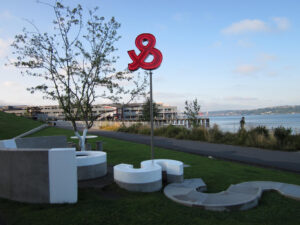
One of Belltown’s most unique features is the famous Olympic Sculpture Park, a free, outdoor collection of impressive of both permanent and traveling works of art. It’s operated by the Seattle Art Museum and is one of the only green spaces downtown.

The Belltown neighborhood even features an off-leash dog park and Community Center. Ran by Seattle Parks and Recreation, the Belltown Community Center features drop-in programs, classes, meeting rooms, and a toddler play area. Check out page 23-24 of this brochure to see what’s happening in the upcoming months – you’d be surprised how many great programs you can get involved in!

If you’re not in the mood for classes, restaurants, or sculptures, check out a film in one of Belltown’s two independent movie theaters. The Big Picture, located on First Avenue, was voted one of the top 20 movie theaters in the world! The Cinerama, located on Fourth Avenue is bigger with a capacity of 570 and owned by Paul Allen. Just make sure to see what’s playing and book in advance – they both only show one film at a time!

Whatever you decide to do in Belltown, make the most of it and have a great time!